


Thin thermal underwear makes a strange promise: that a layer no thicker than ordinary underwear can make you meaningfully warmer. The mechanism behind it is real, it's called moisture-absorption heating, and it's the same principle Uniqlo built Heattech on.
Here's the short version. Your body constantly gives off water vapor, even when you don't feel like you're sweating. Certain fibers — rayon and viscose in particular — attract those water molecules and hold them. When a moving water molecule binds to a fiber surface, it gives up the energy it was using to move around, and that energy is released as heat. The amount from any single molecule is tiny. But it happens continuously, across billions of molecules, for as long as your body keeps producing vapor.
That's the heat generation half. The other half is keeping it. Ultra-fine acrylic fibers woven through the same fabric create pockets of still air, and still air is one of the better insulators available. The heat your body's moisture just generated stays close to your skin instead of drifting off.
So: the fabric doesn't add heat from outside. It converts something your body was already producing into warmth, then keeps it there.
The interesting question is how much. That's where most brands go quiet.
What actually happens at the fiber
Textile scientists call it heat of sorption. Water vapor molecules in the air move constantly; that motion is kinetic energy. Hygroscopic fibers — ones chemically inclined to attract water — pull those molecules onto their surface. Once bound, the molecule stops moving freely, and the energy it was carrying has to go somewhere. It leaves as heat.

Cotton does a version of this, which is why a cotton shirt feels briefly warm in humid air. But cotton has a problem: it holds onto the moisture rather than releasing it, so it goes from warm to clammy to cold. That's why cotton is the wrong fabric for cold weather, and why base layers built for warmth avoid it.

The fibers that work for this are rayon and viscose — both are regenerated cellulose, both are strongly hygroscopic, and both release moisture again rather than staying wet. Pair them with fine acrylic for the insulating air layer and you get the fabric architecture behind essentially every thin thermal base layer on the market.
Our CatWarm knit is 54% viscose, 38% acrylic, 8% spandex — viscose doing the heat generation, micro-acrylic doing the retention, spandex doing the fit.
What the numbers look like
China has a national standard for this — FZ/T 73036-2010, covering moisture-absorption heating knitwear. Annex A sets out the measurement method: the fabric is conditioned, exposed to moisture under specified temperature and humidity, and the temperature change recorded over 30 minutes. Two figures come out of it — the peak, and the average across the full half hour. To be certified, a fabric needs a peak of at least 4.0°C and an average of at least 3.0°C.
| Measurement | Standard requires | Result |
|---|---|---|
| Peak temperature rise | ≥ 4.0°C | 6.4°C |
| Average rise over 30 minutes | ≥ 3.0°C | 3.0°C |

We publish both, because the peak alone would be misleading. 6.4°C — about 11.5°F — is what the fabric does at its most active moment; 3.0°C is closer to what half an hour of wear looks like. The average sits exactly at the certification threshold, which is worth saying plainly rather than leading with the bigger number and hoping nobody asks.
Where far-infrared fits in
Far-infrared is a separate mechanism that often gets bundled into the same marketing sentence, and it shouldn't be.
Certain mineral-loaded fibers re-emit body heat back toward the skin as far-infrared radiation rather than letting it escape. It's measured as emissivity — how efficiently the fabric radiates — under GB/T 30127-2013, which sets a minimum of 0.83. Our fabric measured 0.92, with a 2.0°C rise under that standard's test conditions.
These numbers don't add together. Moisture-absorption heating and far-infrared re-emission are measured by different methods under different conditions, on different aspects of the same fabric. Adding 6.4 and 2.0 to claim "up to 8.4°C" would be nonsense, and any brand doing that arithmetic is telling you something about how it treats the rest of its claims.
What this does not mean
This is the part that usually gets left out, and it matters more than the numbers.
- It's a fabric measurement, not a body-temperature guarantee. The lab conditions the fabric, controls the humidity, and measures the fabric. What you experience depends on your body, your activity level, what you're wearing over it, and the weather.
- The effect scales with your moisture output. If you're sitting still in a dry, unheated room, your body isn't producing much vapor, and there's less for the fibers to convert. The technology works hardest when you're moving — walking to the station, climbing stairs, going in and out of heated buildings.
- It works best against bare skin. Put a cotton layer between you and the fabric and the cotton absorbs the vapor first. The heating fibers never get it.
- It's a base layer, not a coat. Moisture-absorption heating adds a meaningful few degrees at the skin. It doesn't replace a jacket at −15°C.
None of this makes the technology less real. It makes it predictable, which is more useful.
Getting the most out of it
- Wear it directly against skin — nothing cotton underneath.
- Fit matters more than thickness. The air-pocket layer only insulates if the fabric is close to you. Loose defeats it.
- Expect it to shine on transitions. Cold platform, warm train, cold street again — that's where thin thermal layers beat bulky ones, because you're not carrying heat you can't shed.
- Don't over-layer. Two thermal base layers usually perform worse than one plus a real insulating mid-layer.
- Know when you don't need it. Above roughly 10°C, moisture-absorption heating stops being an advantage and starts being a layer you'd rather not have on. That's when a plain seamless pair does the job better.

The honest summary
Moisture-absorption heating is a genuine, measurable technology, not marketing vapor. The effect is modest and continuous rather than dramatic — a few degrees at the skin, sustained, without bulk. Whether that's worth it depends on what you're comparing against: it beats cotton comprehensively, it beats nothing at all obviously, and against a thick wool layer it trades warmth for the ability to wear it under normal clothes.
What we'd suggest looking for, whoever you buy from: a brand that publishes the actual measured figures and names the standard they were measured under. Most don't. That absence is itself information.
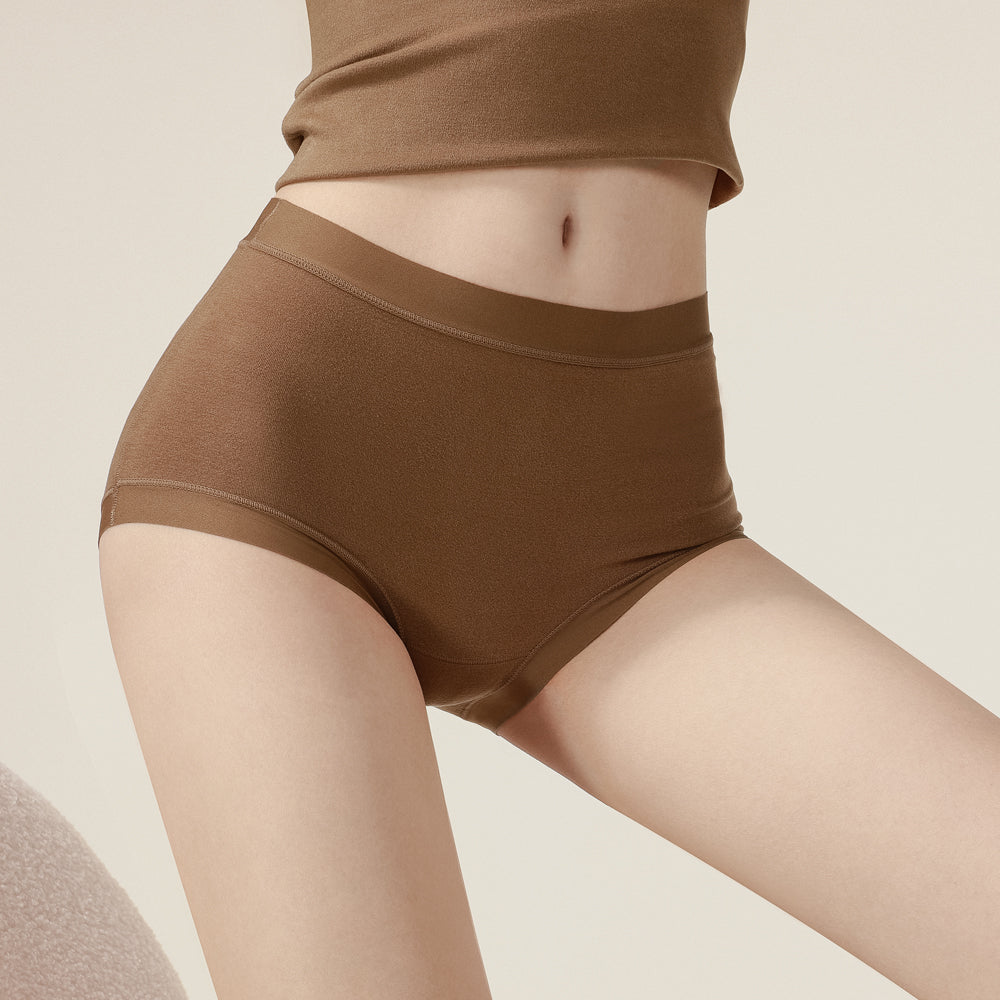
Our CatWarm high-waisted thermal underwear uses the fabric described above — 54% viscose, 38% acrylic. Every figure here comes from third-party laboratory testing, and we publish the reports in full, verification codes included.
For the other three seasons, the Souffle seamless 3-pack is the same idea without the heat — built to disappear under leggings rather than warm you up.
Frequently asked questions
Does moisture-absorption heating actually work?
Yes, the mechanism is real physics — hygroscopic fibers release heat when they bind water vapor molecules. The effect is modest and continuous rather than dramatic. Certified to FZ/T 73036-2010, our fabric recorded a peak rise of 6.4°C against a 4.0°C requirement, and 3.0°C averaged over 30 minutes.
Is this the same technology as Uniqlo Heattech?
It's the same underlying principle. Heattech uses rayon to absorb body vapor and convert it to heat, with fine acrylic fibers trapping the resulting warmth. Any fabric built on hygroscopic cellulose fibers plus micro-acrylic works on that mechanism. What differs between products is the specific blend, the knit construction, and whether the brand publishes measured figures.
Why can't I feel it working?
Because it's a few degrees, sustained, rather than a burst. It's most noticeable by comparison — wearing it on a cold commute versus wearing cotton on the same commute. It's also less active when you're sitting still in dry air, since your body is producing less vapor for the fibers to convert.
Does it still work after washing?
Moisture-absorption heating is a property of the fibers themselves, not a coating, so it doesn't wash out the way a surface treatment would. What can degrade with washing is the knit structure that holds the insulating air layer, which is why wash testing matters. Ours was laundered 100 times and measured 1.5% skew against a 3.5% limit.
Is far-infrared the same thing?
No. Far-infrared re-emits your existing body heat back toward your skin; moisture-absorption heating converts water vapor into new heat. They're measured separately, under different standards, and their figures should never be added together.